Define what good looks like. Prove you're meeting it.

Standards pulls everything together. Set the requirements once, whether that's ISO, a sector or regional framework, or your own internal rules, and the system checks them against the work already happening across the platform. Policies in place and distributed, schedules running, staff trained, checks actually completed. The evidence assembles itself, continuously, site by site.

Try Today

Features

Set the bar once, hold every site to it

Most organizations prove they meet a standard by scrambling once a year, chasing policies, hunting for training records, hoping the checks were done. Standards turns that on its head. You define what meeting a standard means, and because it draws on the work already happening in every other module, it tells you whether you're meeting it right now, not next audit. Here's what's inside.

Any standard, including your own

Build a standard from ISO, a sector or regional framework, or your own internal rules, all treated as first-class. Ready-made ISO packs cover 9001, 14001, 27001, 45001 and 42001 (the new standard for AI management), or use the custom standard builder to draft and publish your own framework. You don't have to hold ISO to get the benefit, though if you do, it's handled really well. Whatever "good" means for your organization, you can define it and hold yourself to it.

  • ISO packs for 9001, 14001, 27001, 45001 and 42001 (AI management)
  • A custom standard builder: draft and publish your own framework
  • ISO supported thoroughly when you need it
  • No requirement to hold any particular certification
Defining a standard and choosing a framework

Enforce or recommend

Decide how firmly each standard applies, enforced as a requirement everyone must meet, or recommended as guidance you want to encourage. That lets you run mandatory baselines and aspirational best practice side by side, without pretending everything carries the same weight. The same engine handles both, so you can tighten or relax as your organization matures.

  • Set a standard as enforced or recommended
  • Run mandatory baselines and best practice together
  • Be clear about what's required versus encouraged
  • Adjust as your organization matures
Enforce versus recommend setting on a standard

Requirements that check the real work

Each requirement is tied to something actually happening in the platform, so "meeting it" means the work is genuinely done, not that a box was ticked. A requirement can check that a policy exists and has been distributed, that a schedule is in place and up to date, that staff are trained, or that a check like a fire door inspection was completed on time. Tag the requirements that are a statutory obligation, so legal duties stand out from best practice. And where there's no system evidence to draw on, you can record manual attestation against the requirement instead. Real evidence, drawn from the day-to-day.

  • Requirements linked to live work, not declarations
  • Check a policy is in place, a schedule is current, staff are trained
  • Tag statutory obligations so legal duties stand out
  • Record manual attestation where there's no system evidence
Requirement pulling evidence from across modules

Roll out across every site

Define a standard once and hold every location to it, "every site runs fire checks, holds these policies and trains its people", then see each site measured against the same bar. Multi-site rollout is built in, so consistency across a portfolio doesn't mean managing each location by hand. One definition, applied everywhere.

  • Apply one standard across every location
  • Hold a whole portfolio to the same bar
  • Built for multi-site from the start
  • Consistency without per-site admin
Standard applied across multiple sites in an estate

A live view, not a yearly scramble

Because the evidence assembles itself as work happens, you can see whether each standard is being met right now, site by site. Gaps show up as they appear, giving you the chance to fix them before an audit rather than discovering them during one. Compliance becomes something you watch, not something you cram for.

  • See whether you're meeting each standard right now
  • Status broken down site by site
  • Gaps surface early, while you can act
  • No annual evidence-gathering scramble
Live standards status dashboard showing requirement status across sites

Free readiness check

Could you prove it tomorrow?

Most teams only find the gaps when someone asks. This finds them first: a readiness score, your biggest gaps, and a plan for each, in about three minutes.

Ready to know where you stand, every day?

Try Today, or book a demo. Be ready the moment someone asks.

Try Today
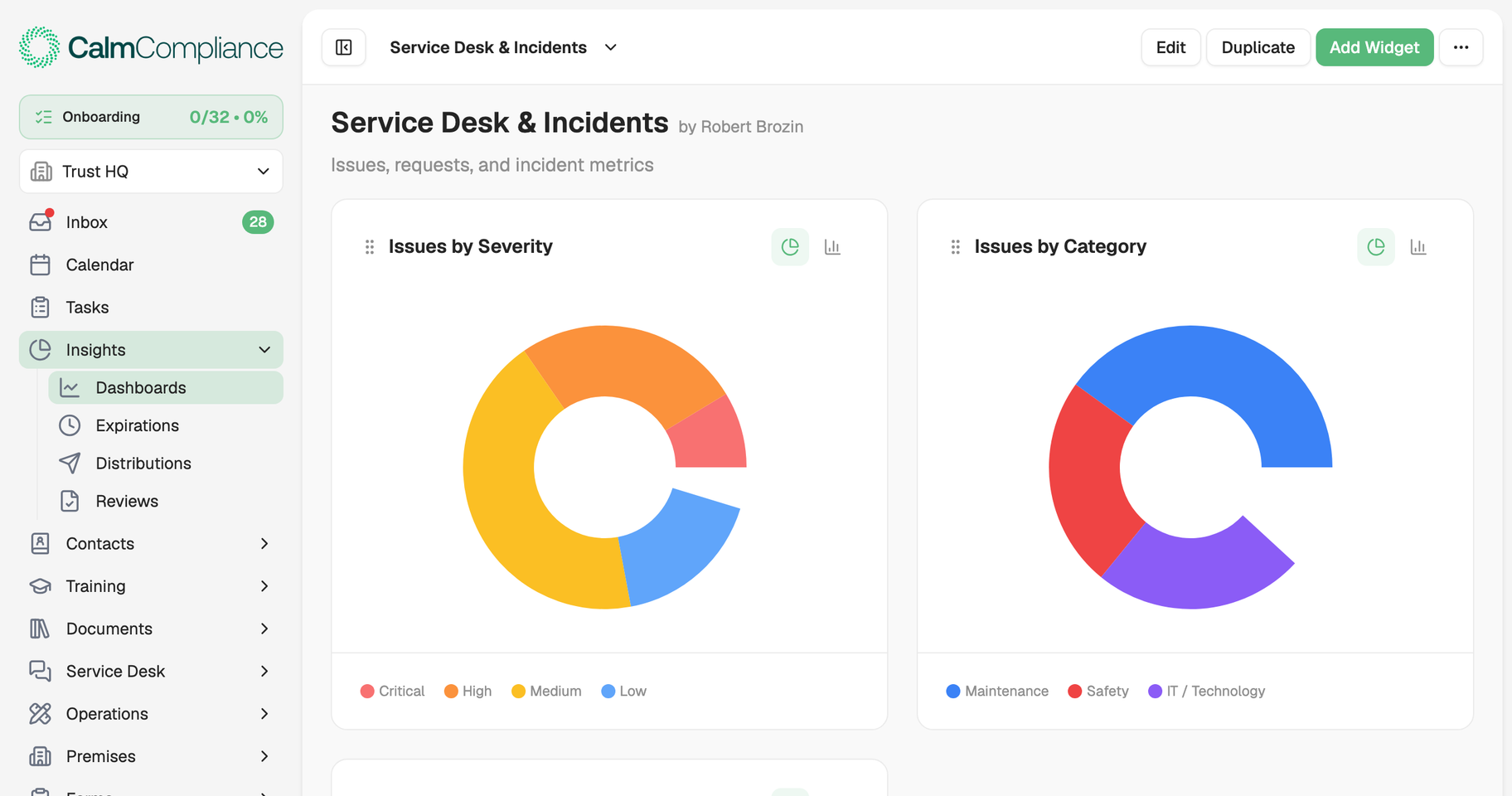
CalmCompliance dashboard showing live standards status across sites